One Narrative, Five Centers: How the Thesis "Iran Threatens the Global Economy" Became Consensus
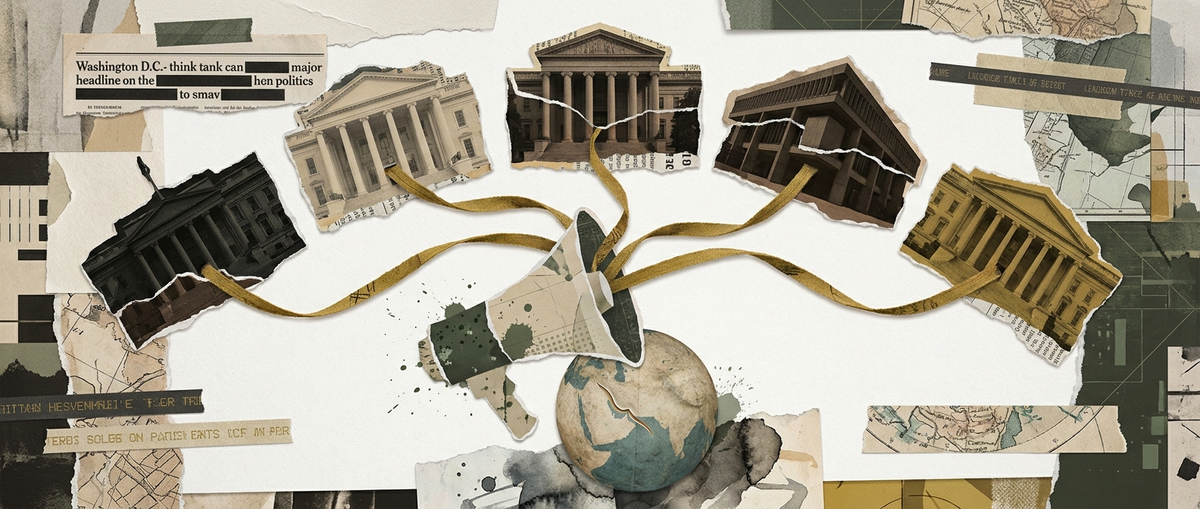
How five think tanks pushed the same thesis at the same time, and why it's not a coincidence, but not a conspiracy either
I. Five Texts, One Thesis
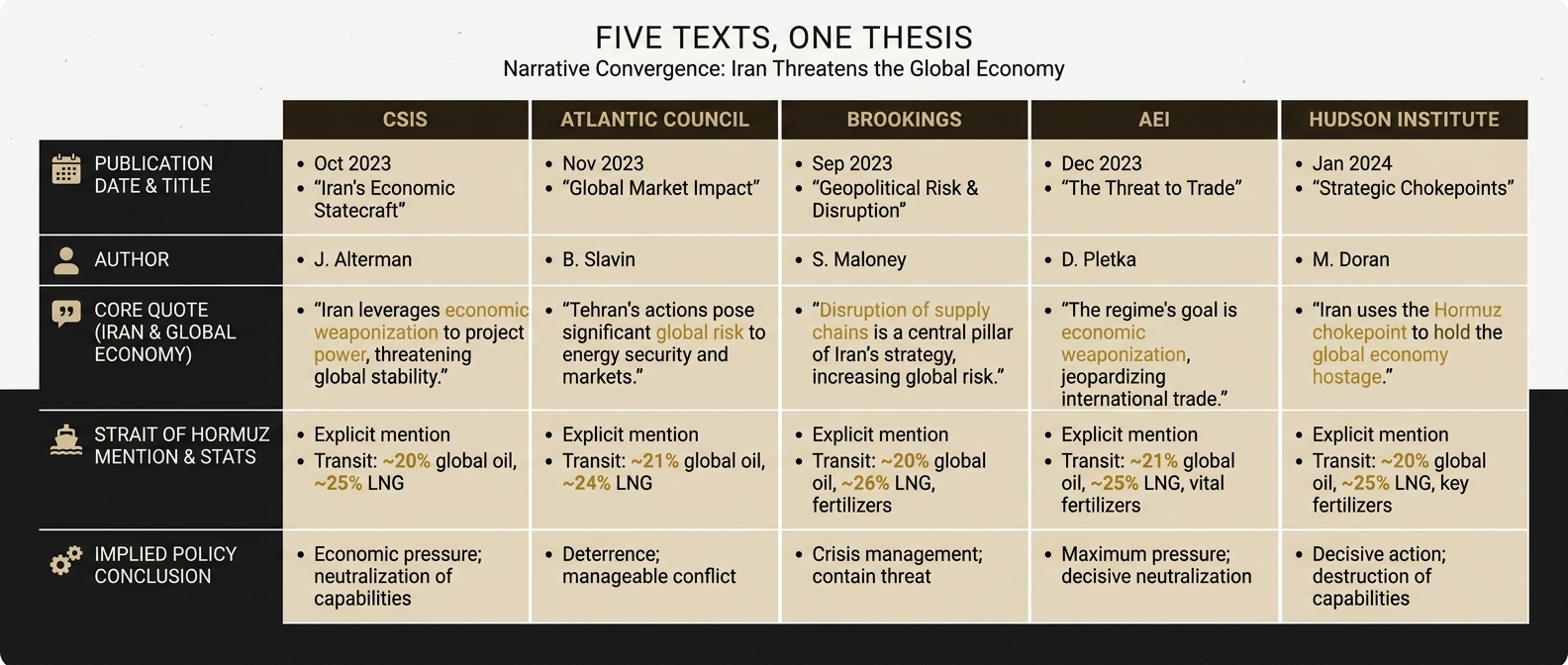
Over three weeks, from March 2 to March 21, 2026, five major Washington think tanks published materials built around the same central argument. Here it is, in five versions:
CSIS (Navin Girishankar, March 11):
"Iran's Real War Is Against the Global Economy", Iran's real war is an economic one. Closing the Strait of Hormuz threatens 20% of the world's oil, energy markets, and global supply chains.
Atlantic Council (Nate Swanson et al., early March):
"Twenty Questions About the Iran War", Iran "is betting that economic pain will force the US to end the war." Its strategy is economic coercion through the Strait of Hormuz.
Brookings (Suzanne Maloney et al., March 2):
"After the Strike: The Danger of War in Iran", "Disruptions in the Strait of Hormuz are spiking energy prices and insurance premiums, threatening export-oriented Southeast Asian economies."
AEI (Desmond Lachman, March 9):
"The Economic Consequences of the Iran War", the war raises the risk of recession, inflation spikes, stock market corrections, and credit market stress. 20% of global oil, 20% of gas, and 20–30% of fertilizers pass through Hormuz.
Hudson Institute (Can Kasapoglu, March 2026):
"Toward a Theory of Victory for the War in Iran", the IRGC "retains powerful levers for global-scale economic escalation, particularly the ability to threaten the Strait of Hormuz and regional desalination infrastructure." These capabilities must be destroyed completely.
Five institutions. Five different authors. Five different political positions. One idea: Iran is weaponizing the economy, and that's a threat to everyone.
II. Coincidence or Coordination?
Before we dig in, the most obvious question needs answering: maybe all five are simply describing reality? Hormuz is closed. Oil prices are surging. Economies are hurting. What's there to coordinate?
The answer: the facts are real, but the framing is a choice.
Fact: Iran closed the Strait of Hormuz.
Fact: this affects the global economy.
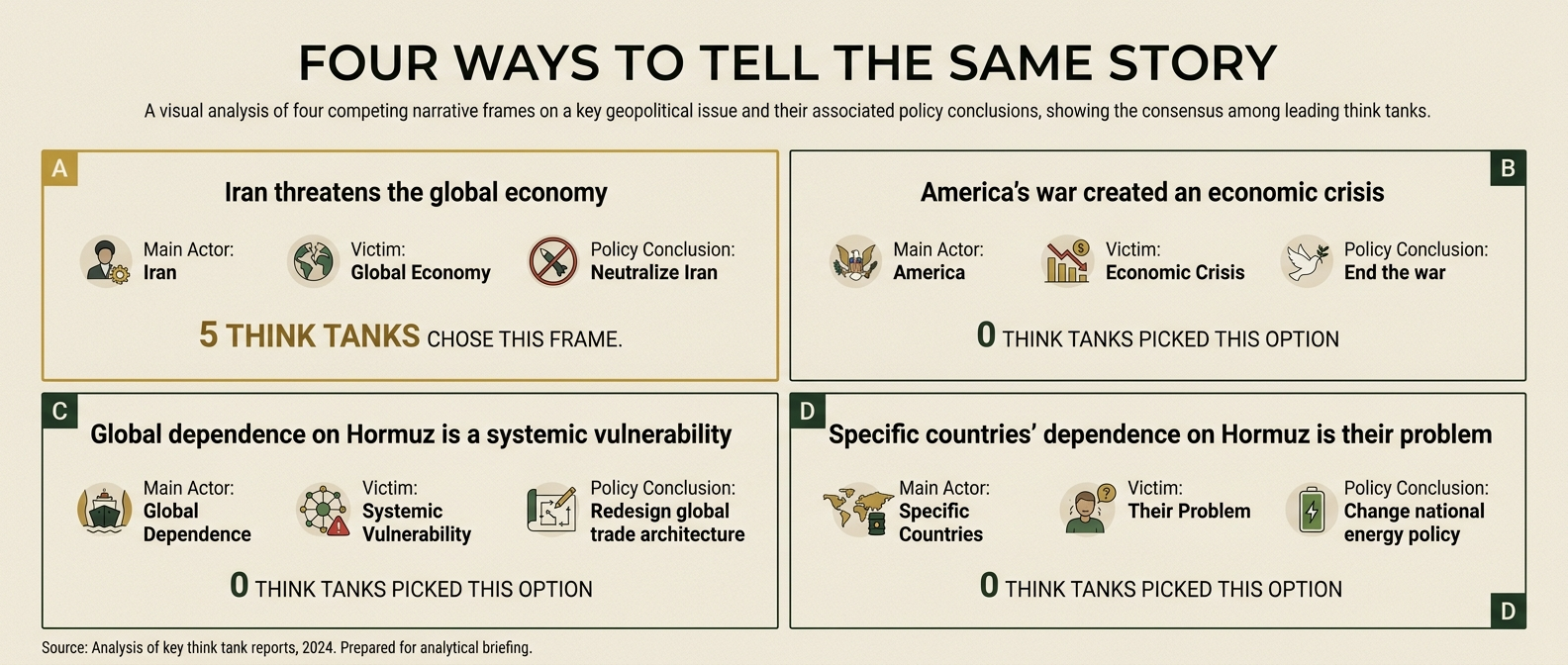
But those same facts can be packaged into fundamentally different narratives:
Narrative A (the one all five chose): "Iran threatens the global economy" → Iran is the aggressor. It must be stopped.
Narrative B (which none of the five chose): "America's war created an economic crisis" → the US is the problem. The war must end.
Narrative C (also chosen by none of the five): "Global dependence on Hormuz is a systemic vulnerability" → neither Iran nor the US is to blame. The architecture of global trade is.
Narrative D (Carnegie, the only one that came close): "Specific countries' dependence on Hormuz is their problem" → Iran isn't threatening anyone. Korea (Japan, India) set themselves up for failure with their energy policies.
All five Washington think tanks chose Narrative A. Iran is the actor. The global economy is the victim. Conclusion: Iran must be neutralized. This choice of framing does not follow from the facts, it follows from the institutional positions of the authors.
III. The Pipeline: From Report to Policy Decision
To understand how a single narrative becomes "expert consensus," you need to see the full chain. We trace it through a concrete example: the thesis "Iran is waging economic war" → the policy decision to escalate military operations.
Link 1: Think Tank Publishes a Report
March 2, Brookings: Maloney publishes "After the Strike", the first major analytical piece on the war. Key thesis: Iran responded to the strike by closing Hormuz, creating a global economic crisis. Maloney is a former State Department adviser and former ExxonMobil employee.
March 9, AEI: Lachman publishes "Economic Consequences", a pure economic analysis. Recession, inflation, market collapse. Lachman is a former Deputy Director of the IMF and former Managing Director at Salomon Smith Barney. Worth noting: he criticizes Trump ("war of choice," "whatever happened to America First?"), but he doesn't challenge the "Iran as economic threat" frame itself.
March 11, CSIS: Girishankar publishes "Iran's Real War Is Against the Global Economy." The headline says it all: Iran's real war is economic. Girishankar is a former World Bank official and Bridgewater alumnus.
Link 2: Media Pick It Up
Reports from CSIS, Brookings, and AEI get cited almost instantly:
• Reuters (March 20): "Which economies will hurt most from Iran war?", references Goldman Sachs forecasts and WTO data, reproducing the "Iran created an economic crisis" frame
• CFR Daily News Brief (March 20): "The Iran War's Global Economic Impact", compiles WTO, Goldman Sachs, and Reuters data, embedding it all in the "economic threat" narrative
• Journalist's Resource (March 20): "4 Takeaways on the Economic Consequences of the Iran War", cites AEI (Lachman), WTO, and the Fed
• NYT (March 23): "Energy Attacks in War on Iran Could Turn Economic Shock Into Long-Term Damage"
• Euronews (March 16): "Markets may be underestimating how the Iran war could hit the global economy"
Pay attention to how this works: CFR, itself a think tank, reprocesses material from other think tanks and news outlets into its own digest. Journalists quote think tanks as "independent experts." Think tanks cite each other. A closed loop forms: CSIS → Reuters → CFR → NYT → back to CSIS (as validation), and round it goes.
Link 3: The Policy Decision
March 20, WSJ: American warplanes and helicopters launch an operation to "unblock Hormuz", strikes on Iranian positions near the strait.
March 20, Treasury Secretary Bessent (Fox Business): Washington is considering lifting sanctions on some Iranian oil, meaning the problem is being treated as an "economic threat from Iran," not as "a consequence of our decision to start a war."
Seven allies (March 20): The UK, France, Germany, Italy, the Netherlands, and Japan issue a joint statement on the need to guarantee free passage through Hormuz, again, framed as "Iran threatens global trade."
What We See
The pipeline works:
Think tank publishes a report
→ Media cite it → other think tanks reference it
→ "expert consensus" forms
→ policymakers make decisions within the frame of that consensus
→ think tanks comment on the decision → the cycle repeats
Nobody is coordinating. The system coordinates itself.
IV. Five Centers: One Narrative, Five Angles
While all five think tanks push the same thesis ("Iran threatens the global economy"), each does it differently, and the differences in emphasis reveal institutional interests.
CSIS: "The Economy Is a Battlefield"
Emphasis: Iran is waging economic war. This is not a side effect of the military conflict. It's a deliberate strategy.
Why CSIS needs this: CSIS receives $6.23 million from defense contractors and $2.23 million from foreign governments. The "economic war" frame expands the concept of "security" beyond the military sphere into territory where CSIS has unique expertise (technology, trade, CHIPS Act). Girishankar heads the Economic Security and Technology division. His career path (World Bank → Bridgewater → CHIPS Act) fits this frame like a glove.
Message to the audience: "You need to invest more in economic security. We're the experts. Call us."
Atlantic Council: "Iran Is Betting That Economic Pain Will Stop Us, but We're Tougher Than That"
Emphasis: economic damage is Iran's weapon, but America can take the hit. The key is not to back down.
Why Atlantic Council needs this: Atlantic Council receives money from the Pentagon, the State Department, the UAE, Bahrain, and defense contractors. Its authors are former officials who wrote the very policies they're now commenting on. The "economic pain is manageable" frame makes it possible to justify continuing military operations without denying that economic problems exist.
Message to the audience: "Yes, it hurts. But the alternative is worse. Stay the course."
Brookings: "We Warned You, and We'll Keep Warning You"
Emphasis: the war creates cascading economic risks, from energy to insurance, from Southeast Asia to Europe. The legal precedent is dangerous.
Why Brookings needs this: Brookings received $24.44 million from government, defense contractors, and foreign states. But Brookings positions itself as "centrist" and "academic", it can't be a hawk (Atlantic Council) or a dove. The "we're warning you about the risks" frame lets it simultaneously legitimize the war (without calling for its end) and distance itself from the consequences (we told you so).
Maloney is a former ExxonMobil employee and State Department official. Her analysis is meticulous, but it never reaches the conclusion that "the war was a mistake." The furthest it goes: "the war creates risks that need to be managed." For a former oil industry figure working at a think tank with $24 million from government and corporate sources, this is the perfect position: critical enough to preserve academic credibility, loyal enough to keep the funding flowing.
AEI: "The War Is Hammering the Economy, but It's Trump's Fault, Not the War Itself"
Emphasis: the economic consequences are severe. Trump is waging a "war of choice." His tariff policy makes things worse. But the "Iran is an economic threat" thesis goes unquestioned.
Why AEI needs this: AEI is a conservative think tank that doesn't fully disclose its funding sources. Lockheed Martin and Northrop Grumman are among its donors (publicly confirmed by an AEI event moderator). Lachman is the most independent voice in our sample: former IMF Deputy Director and former Salomon Smith Barney strategist, he criticizes Trump openly. But his criticism is tactical, not strategic: he doesn't say "the war is a mistake." He says "war plus tariffs plus attacking the Fed is a toxic combination."
The "Iran as economic threat" frame stays intact because it's compatible with AEI's position on Iran's nuclear program. AEI has pushed a hard line on Iran for decades. Publishing criticism of the war's economic fallout is acceptable. Questioning the necessity of confronting Iran is not.
Hudson Institute: "Iran's Economic Threat Is One More Reason for Total Destruction"
Emphasis: the IRGC retains "powerful levers for global-scale economic escalation." The only way to eliminate the threat is the complete destruction of Iran's military capacity.
Why Hudson needs this: Hudson Institute is the most hawkish of the five. Its primary audience is Republican hawks and the pro-Israel lobby. Hudson doesn't disclose its funding, but it's known for close ties to the defense industry and pro-Israel donors.
Kasapoglu is a Turkish military analyst whose career is built on NATO-centric threat analysis. His frame: Iran is an existential threat that can't be "contained" or "managed", only destroyed. Iran's economic weapons (Hormuz, desalination infrastructure) aren't an argument for ending the war. They're an argument for escalating it.
V. What Nobody Says
The most important thing in narrative analysis isn't what gets said. It's what doesn't.
1. "The War Is the Main Cause of the Economic Crisis, Not Iran"
The closure of Hormuz is a response to the strike on Iran launched on February 28. No strike, no closure. No closure, no oil shock. But none of the five think tanks builds its narrative from that starting point.
The closest is AEI (Lachman): "Trump's war of choice." But even he doesn't take the logical next step: if the war is a choice, then the economic crisis is a consequence of that choice, not of some "Iranian threat."
2. "Iran Is Acting in Self-Defense"
The Iranian narrative, that closing Hormuz is a response to unprovoked aggression, is completely absent from all five texts. That doesn't mean the Iranian narrative is correct. But its absence from analysis that claims to be comprehensive is a systemic failure.
3. "The Economic Consequences Are an Argument for an Immediate Ceasefire"
None of the five think tanks draws this conclusion. CSIS, Atlantic Council, and Hudson favor continuation or escalation. Brookings favors "careful risk management." AEI wants tariff policy reform (but not an end to the war). Carnegie pushes for energy diversification.
The conclusion "the war is economically devastating → we should stop the war" is logically straightforward but institutionally impossible for any of these organizations. Why?
Because their funding, staff, and audiences are all tied to the system waging this war.
4. "Iran's Allies Are Profiting from the Hormuz Closure"
Russia is an oil and gas exporter with no dependence on Hormuz. Every dollar increase in the price per barrel is direct revenue for the Russian budget. China, the largest importer of Iranian oil, gets it at discounted prices, circumventing sanctions. India is negotiating its own deals on the side.
None of the five think tanks analyzes who benefits from the Hormuz closure in geostrategic terms. This is remarkable for institutions whose core function is geopolitical analysis.
5. "The Global Economy's Dependence on a Single Strait Is an Architectural Problem, Not an Iranian One"
The Strait of Hormuz is a bottleneck in world trade not because Iran is bad, but because the global energy architecture hasn't been rebuilt in the 50 years since the first oil shock of 1973. Carnegie came closest to this conclusion (Longread #3), but even it framed it as "Korea's problem" rather than a systemic failure.
VI. A Mechanism Without a Conspiracy
How do five independent institutions arrive at the same narrative without coordination? The mechanism has four components:
Component 1: A Shared Talent Pool
The authors at all five think tanks are graduates of the same universities (Harvard, Georgetown, Johns Hopkins SAIS), veterans of the same government agencies (NSC, State Department, Pentagon, the intelligence community). They know each other personally. They read the same sources. They think in the same categories.
This isn't a conspiracy. It's socialization. Twenty years in Washington's foreign policy establishment creates a particular worldview in which Iran is a threat, Hormuz is a vulnerability, and military force is a tool for solving problems. Alternative frames (diplomacy, ceasefire, energy restructuring) are absent not because someone banned them, but because they simply don't occur to a former NSC Director for Iran.
Component 2: A Common Funding Structure
All five think tanks (except Carnegie) receive substantial funding from defense contractors that directly profit from the war's continuation. All five get money from the US government or its allies. None is funded by antiwar organizations, Iranian diaspora foundations, or independent peace researchers.
Money doesn't buy specific conclusions. Money buys the people who reach those conclusions on their own.
Component 3: The Media Echo Chamber
Think tanks and the media exist in symbiosis. Journalists need "experts" to quote. Think tanks need media presence for influence and fundraising. The result: a think tank publishes a report → a journalist quotes it → another think tank cites the quote → a third journalist writes "all experts agree."
This mechanism transforms the coincidence of five opinions into "consensus." Consensus isn't when everyone agrees. Consensus is when the dissenters don't get quoted.
Component 4: Institutional Self-Preservation
None of the five think tanks can afford to be radically different from the others. A think tank that says "the war is a mistake, ceasefire now" loses access to officials (they stop giving briefings), to defense contractors (they stop writing checks), and to the media (editors stop calling for comment). An institute that falls outside the "mainstream" gets marginalized.
The Quincy Institute for Responsible Statecraft, the only Washington think tank consistently criticizing the Iran war, receives zero from defense contractors and is not cited as an "expert voice" in CNN, NYT, or WaPo reporting. This is not an accident. This is the price of dissent.
VII. Exceptions and Counterexamples
To be fair, Washington's expert community isn't monolithic.
The Quincy Institute consistently publishes antiwar analysis. But Quincy is small, young (founded in 2019), and marginalized. Its budget is around $7 million, compared to $40+ million for CSIS or $100+ million for Brookings.
Desmond Lachman (AEI) is the most critical voice among mainstream think tank authors. His "war of choice" is a direct challenge to the administration. But Lachman is an economist (78 years old, former IMF), not a strategist. His criticism is tactical, not strategic. And it's published in AEI, a think tank that has pushed a hard line on Iran for decades. The organization allows criticism of the war's consequences, but not criticism of the decision to go to war.
Carnegie (Longread #3) is the only major think tank to offer a fundamentally different frame: not "Iran threatens the economy" but "Korea's energy dependence is a structural problem." That's closer to Narrative C/D than to Narrative A. It's no coincidence that Carnegie receives the least defense money ($620K vs. Millions for its competitors).
VIII. A Practical Takeaway: How to Read Think Tanks
For journalists, analysts, and anyone who reads carefully, a set of questions worth asking about every think tank report:
1. Who wrote it? A former official? From where? When did they leave? Did they help shape the policy they're now commenting on?
2. Who's paying? Is the think tank funded by defense contractors? Foreign governments? Check the Think Tank Funding Tracker (thinktankfundingtracker.org).
3. What's the frame? Who's the actor (Iran threatens? The US created the crisis?)? Who's the victim? What conclusion is implied?
4. What's NOT being said? Which alternative explanations are missing? Is the other side's voice present?
5. Who else is saying the same thing? If five think tanks are saying the same thing, that's not "consensus." That's a reason to ask: why aren't there any dissenters?
6. Where does money → report → media → policy lead? Trace the chain: who funded the think tank → who wrote the report → which media outlets cited it → what policy decision followed.
IX. Instead of a Conclusion
Five think tanks. One narrative. This isn't a conspiracy. It's worse: it's a system that produces consensus without coordination, promotes war without orders, and marginalizes dissenters without censorship.
The system works not because anyone is evil. It works because every component, recruitment, funding, the media echo chamber, institutional self-preservation, acts rationally within its own frame. A former NSC director goes to a think tank because it's the best job available. The think tank hires them because their "expertise" attracts attention. A defense contractor funds the think tank because its analysis aligns with business interests. A journalist cites the think tank because they need an "expert." Every step is rational. The aggregate result is irrational: a country wages a war that its own experts consider economically devastating, but not one of them can say "stop."
In future installments of this series, we'll continue breaking down specific reports. But we hope that after these two longreads, "Who Writes" and "One Narrative", readers will look at any think tank report not as "independent expertise" but as a text written by a specific person with a specific biography, at a specific institution with specific funding, for a specific audience with specific expectations.
This doesn't mean think tanks are useless. They produce enormous amounts of quality analysis. But you need to read them critically, understanding who's speaking, why, and on whose dime.