The Chip That Runs on Hormuz: How Carnegie Discovered Korea's Energy Problem
A critical read of "The Iran War Is Also Now a Semiconductor Problem" — Carnegie Endowment for International Peace, Darcie Draudt-Véjares and Tim Sahay, March 13, 2026
I. The Day the Stock Market Noticed Geography
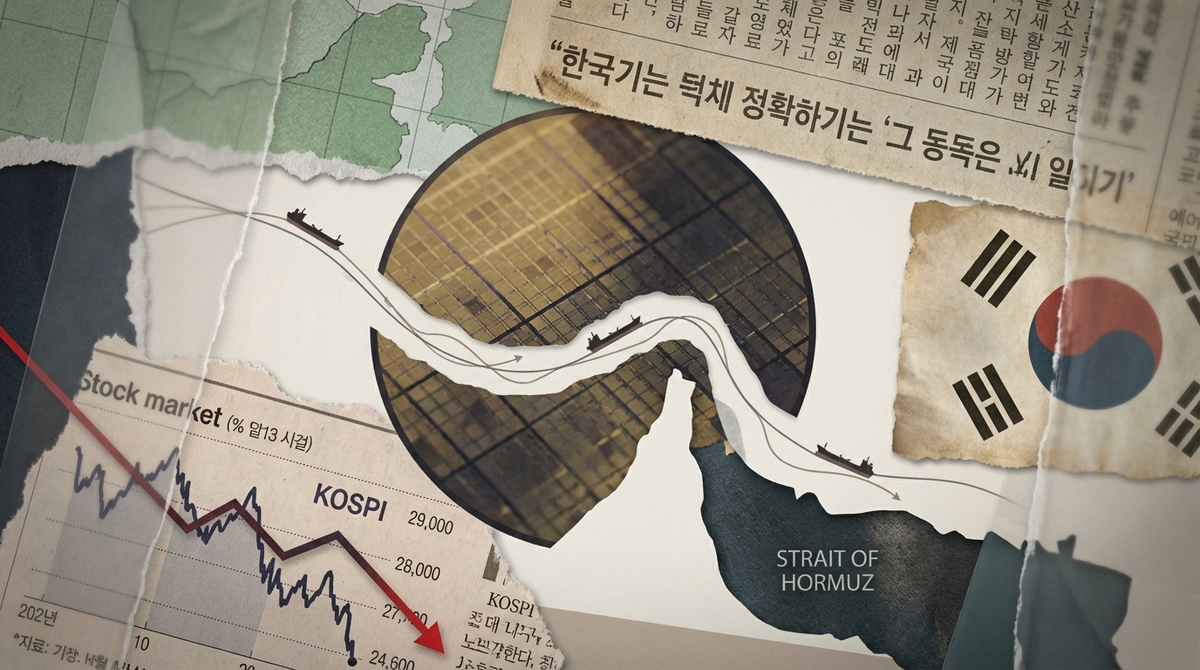
On March 4, 2026 — four trading days into a war that most South Koreans had been told was America's problem — the KOSPI, South Korea's benchmark stock index, posted its worst single-day decline in recorded history. Over those four days, the index lost 18 percent of its value, wiping out more than $500 billion in market capitalization. Samsung Electronics and SK Hynix — the twin pillars of the Korean semiconductor industry — each shed over 20 percent in two trading sessions before a shaky partial recovery.
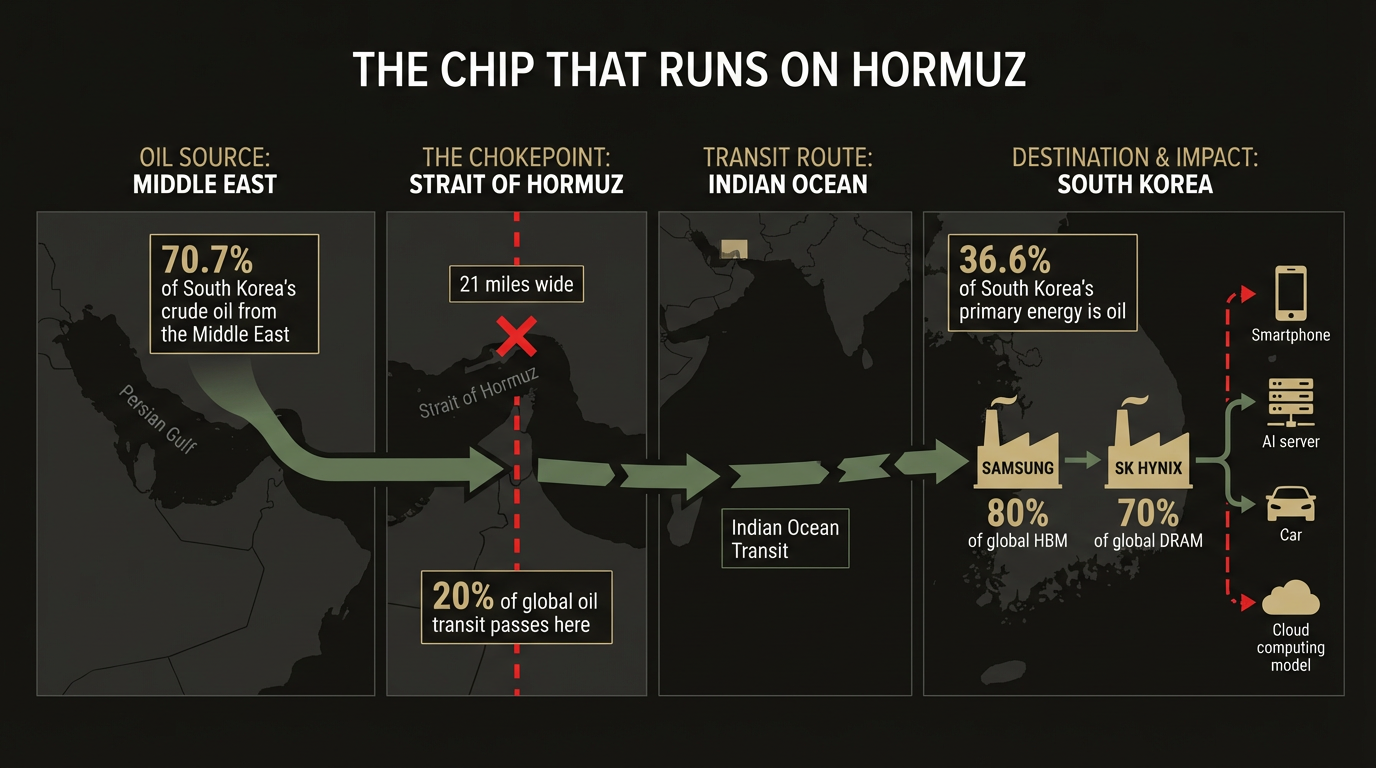
The proximate cause was obvious: Iran had closed the Strait of Hormuz, the 21-mile-wide maritime corridor through which roughly 70 percent of South Korea's crude oil imports travel. The deeper cause — the one that explained why Seoul's stock market was crashing harder than Tokyo's, harder than Mumbai's, harder than any other non-Middle-Eastern financial market on Earth — was less obvious, and considerably more interesting.
It was the subject of a short commentary published by the Carnegie Endowment for International Peace on March 13, 2026, titled "The Iran War Is Also Now a Semiconductor Problem." Written by Darcie Draudt-Véjares, a fellow in Carnegie's Asia Program, and Tim Sahay, co-editor of The Polycrisis at Phenomenal World and co-director of the Net Zero Industrial Policy Lab at Johns Hopkins University, the piece made a simple but consequential argument: the world's most important memory-chip producers depend on energy supplies that move through some of the most geopolitically volatile waterways on Earth, and nobody had done much about it.
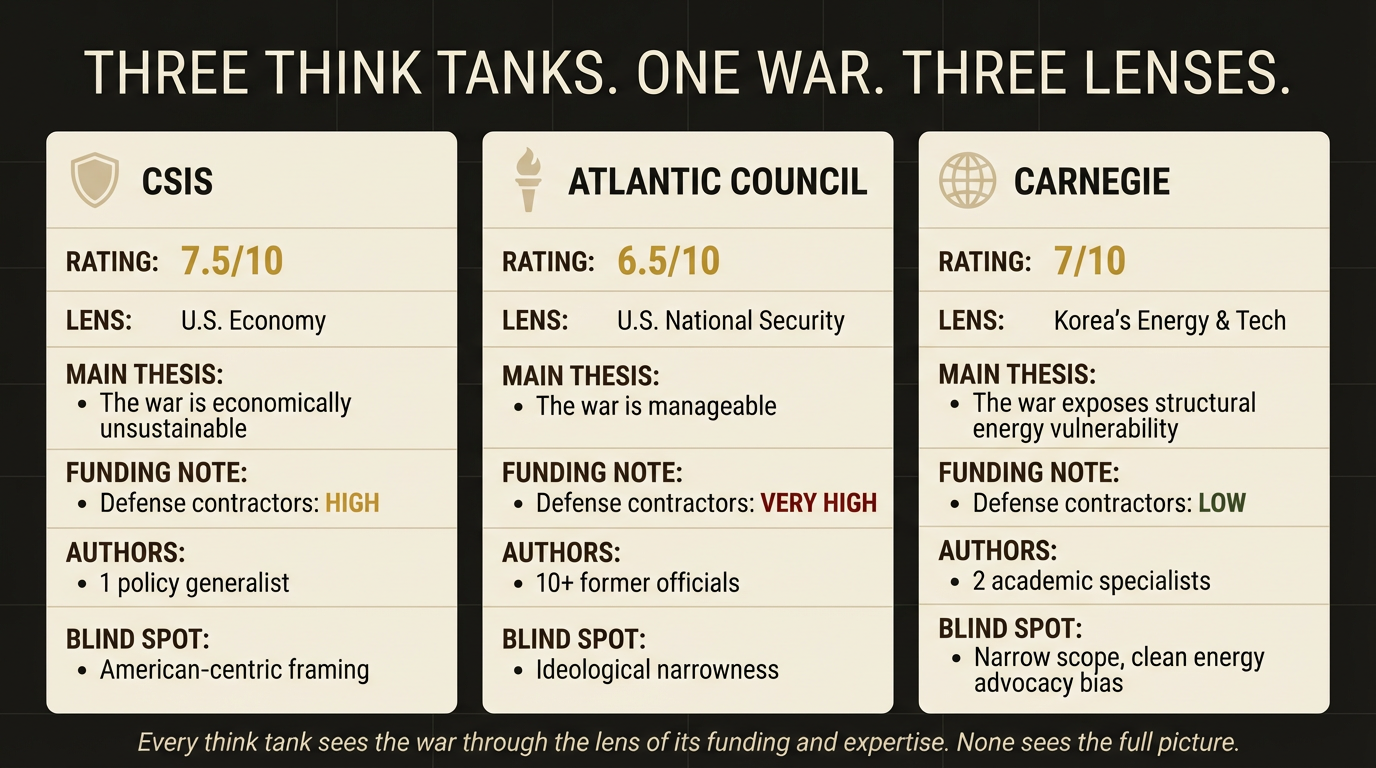
This is a different kind of think tank report than the ones we have examined so far in this series. Where CSIS offered a macroeconomic damage assessment of the war and Atlantic Council assembled a FAQ-shaped consensus document, Carnegie has produced something narrower and, in some ways, more useful: a focused policy argument about a specific vulnerability, aimed at a specific audience, with specific recommendations. It deserves to be taken seriously on its own terms — and then questioned for what it leaves out.
II. The Institution: Carnegie's Unusual Position
The Carnegie Endowment for International Peace occupies a peculiar position in Washington's think tank ecosystem. Founded in 1910 by Andrew Carnegie — the steel magnate who spent the last decades of his life trying to give away his fortune — it is the oldest international affairs think tank in the United States, predating the Council on Foreign Relations by eleven years and the Brookings Institution by six.
Unlike CSIS or the Atlantic Council, Carnegie was not born from the national security establishment. It was born from a robber baron's guilt and idealism — Carnegie's stated belief that "the most disgraceful and fatal thing" was war between civilized nations. This origin story matters, because it has produced an institution with a genuinely different intellectual DNA from its Washington neighbors.
The money. Carnegie's funding profile is notably different from the institutions we have previously analyzed. According to the Quincy Institute's Think Tank Funding Tracker, Carnegie has received approximately $620,000 from Pentagon contractors since 2019 — compared to tens of millions at CSIS and the Atlantic Council. It has received approximately $3.8 million from the U.S. government over the same period. These are not trivial sums, but they are an order of magnitude smaller than the defense-industrial money flowing through the other major Washington think tanks.
Carnegie's primary funding comes from its original endowment (Andrew Carnegie's $10 million gift in 1910, compounded over 116 years), private foundations, and individual donors. This does not make it neutral — no institution with a $400 million endowment and a Washington headquarters is neutral — but it does create different institutional incentives. Carnegie is not primarily dependent on defense contractors for its operating budget. This shows in the analysis.
The structure. Carnegie operates six global centers: Washington, Brussels, Beirut, New Delhi, Singapore (housing Carnegie China), and Berlin. This multinational architecture is unique among American think tanks and produces genuinely different perspectives. When Carnegie publishes on the Iran war, it can draw on scholars who actually live in the Middle East, in Asia, in Europe. The Atlantic Council, by comparison, publishes from Washington about the world. Carnegie, at its best, publishes from the world about the world.
The board. The Carnegie board of trustees is chaired by Jane D. Hartley, former U.S. Ambassador to the United Kingdom and France. The vice chair is Deven J. Parekh, managing director of Insight Partners, a technology-focused private equity firm. Other trustees include Jim Balsillie (co-founder of BlackBerry and chair of the Centre for International Governance Innovation) and a roster of former diplomats, academics, and private equity executives. The board is considerably more diverse — geographically, professionally, and intellectually — than the defense-contractor-adjacent boards of CSIS and the Atlantic Council.
The president. Carnegie is led by Mariano-Florentino Cuéllar, formerly a Justice of the California Supreme Court and a Stanford law professor. His appointment in 2023 represented a deliberate shift away from the foreign-policy-establishment mold: Cuéllar is a legal scholar with expertise in immigration and administrative law, not a defense intellectual.
None of this means Carnegie is free from bias. It means the bias runs in different directions — toward clean energy advocacy, toward multilateral frameworks, toward academic rather than military perspectives. These biases are present in the semiconductor report, and we will identify them.
III. The Authors: An Academic and an Advocate
Understanding who wrote this piece is essential to reading it properly.
Darcie Draudt-Véjares (pronounced "drought-VEY-harez") is a fellow for Korean Studies in the Carnegie Asia Program. She holds a PhD in Political Science from Johns Hopkins University, an MA in Korean Studies from Yonsei University's Graduate School of International Studies, and an AB in Anthropology from Davidson College. She is proficient in Korean and has worked at the Korea Economic Institute, the National Bureau of Asian Research, and the Council on Foreign Relations. She has published extensively on inter-Korean relations, Korean domestic politics, and technology policy.
This is a genuine Korea specialist — someone who reads Korean-language sources, has lived in South Korea, and understands the country's political economy from the inside. Her perspective is grounded in primary research rather than the secondhand expertise that characterizes much Washington analysis of Asia.
Tim Sahay is the co-editor of The Polycrisis at Phenomenal World — a left-leaning political economy publication — and co-director of the Net Zero Industrial Policy Lab at Johns Hopkins. His work focuses on the intersection of climate policy, industrial strategy, and geopolitics. He is not a Korea specialist; he is a clean-energy policy advocate who brings an analytical framework in which fossil fuel dependence is inherently a vulnerability and renewable energy is inherently a solution.
The combination is revealing: a Korea expert paired with a clean-energy advocate, publishing at a think tank with a relatively small defense-industry footprint. The result is analysis that takes South Korea's perspective seriously (rather than treating it as a footnote to American strategy), but which has a clear directional bias toward renewable energy and energy independence as the answer to Korea's problems.
This bias is not hidden — the authors disclosed it by citing their own 2025 report on a Korean "clean chip" strategy. But it is worth naming explicitly, because it shapes what the report recommends and what it does not.
IV. The Argument, Unpacked
The Carnegie commentary advances four interconnected claims. Let us examine each.
Claim 1: South Korea's Stock Market Crash Was an Energy Crisis, Not Just a War Panic
What Carnegie says: The KOSPI's 18 percent crash in four days was not merely a function of general war panic. It was specifically driven by the energy security dimension — the realization that Korea's semiconductor-heavy economy depends on oil that flows through a now-closed chokepoint.
Fact-check: Confirmed. Bloomberg reported the 18 percent crash over four trading days (March 3–4, 2026). Reuters confirmed "more than $500 billion in market value" wiped out. Al Jazeera described it as "South Korea's steepest fall in history." The crash was disproportionately concentrated in semiconductor stocks: Samsung and SK Hynix each lost over 20 percent. A recent Reuters analysis (March 26) argues the panic "made South Korean stocks cheaper, not weaker" — suggesting the fundamental war-risk was overpriced.
The question Carnegie doesn't ask: Was the crash driven by energy fundamentals, or by algorithmic trading and leveraged retail investors? Bloomberg separately reported that the crash "wiped out leveraged bets" — suggesting that the severity of the decline was partly a function of Korea's notoriously leveraged retail investor culture. The energy vulnerability is real, but the stock market crash is an imperfect measure of it.
Claim 2: Korea Imports 70 Percent of Its Crude Oil from the Middle East, Virtually All Through Hormuz
What Carnegie says: South Korea's energy mix is dominated by imported fossil fuels: oil (36.6 percent of primary energy), coal (22.3 percent), and natural gas (19.7 percent). Roughly 70 percent of crude oil imports come from the Middle East, and virtually all of it passes through the Strait of Hormuz.
Fact-check: Confirmed from multiple sources. The Korea International Trade Association data, as reported by the Korea JoongAng Daily (March 8, 2026), puts the figure at 70.7 percent of crude oil and 20.4 percent of LNG from the Middle East. The IEA's energy mix data for Korea confirms the 36.6/22.3/19.7 split. The Hani Shinmun (Korean-language) confirms that "virtually all" of Korea's Middle Eastern oil transits Hormuz. The U.S. Energy Information Administration notes that China, India, Japan, and South Korea together accounted for 69 percent of all Hormuz crude flows in 2024.
The question Carnegie doesn't ask: How much strategic petroleum reserve does Korea hold, and how long can it sustain normal operations without Hormuz flows? This is the most operationally relevant question for a crisis analysis, and the commentary does not address it. (South Korea's strategic reserve, as of late 2025, stood at approximately 96 days of import coverage — one of the highest in the OECD. This does not eliminate the vulnerability, but it does change the urgency calculus significantly.)
Claim 3: Samsung and SK Hynix Dominate Global Memory, Making Korea's Energy Problem Everyone's Problem
What Carnegie says: Together, Samsung and SK Hynix account for 80 percent of high-bandwidth memory (HBM) and nearly 70 percent of the DRAM market. These are foundational technologies for AI, cloud computing, smartphones, and automobiles. Any disruption to Korean chip production would ripple through the entire global technology supply chain.
Fact-check: Approximately correct, but nuanced. The 80 percent HBM figure refers to a projected combined market share for 2027 (HBM4 era), per TechInsights (December 2025). For 2026 (HBM3E era), the projected combined share is 77 percent. As of Q2 2025, SK Hynix alone held 62 percent of HBM shipments (Counterpoint Research), with Samsung at 17 percent and Micron at 21 percent. Combined Samsung + SK Hynix share: approximately 79 percent.
The DRAM figure is more straightforward. As of early 2026, Samsung and SK Hynix together hold approximately 70 percent of the global DRAM market by revenue, with Micron holding most of the remainder.
The larger picture: The claim is substantively correct even if the specific numbers require light qualification. Korean companies do dominate global memory-chip production, and any sustained disruption to their operations would have massive downstream effects. The AI boom has intensified this dependency: Bloomberg reported in February 2026 that chip prices had reached "historic highs," and Fortune noted a memory-chip shortage even before the Hormuz crisis.
The question Carnegie doesn't ask: How much of Samsung's and SK Hynix's production is actually located in South Korea, versus their overseas facilities? Samsung operates a massive semiconductor facility in Austin and Taylor, Texas. SK Hynix has a significant presence in China (Wuxi and Dalian). The geographic distribution of actual production capacity matters enormously for assessing the real-world impact of a Korean energy crisis — and the commentary does not address it.
Claim 4: The Yongin Mega-Cluster Will Need 16 Gigawatts — 17 Percent of Peak National Demand
What Carnegie says: The Yongin semiconductor cluster, currently under construction and scheduled to partially open in 2027, will need 16 gigawatts of power. Since national peak demand is approximately 94 gigawatts, the complex alone would require roughly 17 percent of peak electricity.
Fact-check: Approximately confirmed. The Gyeonggi Research Institute's assessment, which Carnegie cites, puts the figure at 16 GW. Korea's Industry Minister Kim Wan-sup, in a December 2025 statement reported by the Korea Herald, described the Yongin cluster's total electricity consumption as equivalent to "15 nuclear power reactors, or 15 gigawatts." The 15–16 GW range is consistent across sources.
However, context matters: the Yongin cluster is a decades-long project with phased development. The full 16 GW demand will not materialize at opening in 2027 — it represents a long-term projection for a fully built-out complex. Carnegie's framing implies a more imminent energy challenge than the timeline warrants.
The question Carnegie doesn't ask: Who is building this cluster, and what energy commitments have Samsung and SK Hynix actually made? Samsung has joined the RE100 initiative, committing to source 100 percent of its electricity from renewables in some markets. But its Korean operations remain overwhelmingly fossil-fuel-powered. The gap between Samsung's international clean-energy commitments and its domestic energy reality is a story in itself — one that would complicate Carnegie's clean-energy narrative by introducing questions about corporate incentive structures.
V. Carnegie's Recommendations: Sound Policy or Advocacy?
The commentary offers two specific recommendations:
1. Expand domestically sourced energy — nuclear and renewables — to reduce dependence on imported fossil fuels.
The comparison with Taiwan is particularly instructive. Carnegie notes that Taiwan, like Korea, imports 95 percent of its energy and sits at the nexus of strategic maritime trade routes. Yet TSMC has committed to sourcing 100 percent renewable electricity by 2040. The implication: if Taiwan can align energy policy with semiconductor strategy, Korea can too.
This is a fair point, but it elides significant differences. Taiwan has a single dominant chipmaker (TSMC) that can make unilateral corporate commitments. Korea has two major players (Samsung and SK Hynix) whose competitive dynamics complicate coordinated action. TSMC's 2040 renewable commitment is also notably aspirational — Taiwan in 2024 derived less than 10 percent of its electricity from renewables.
2. Modernize the electricity grid by removing regulatory barriers to transmission expansion.
Carnegie cites a 2026 agreement between Gyeonggi Province and Korea Electric Power Corporation (KEPCO) to build new transmission lines beneath a highway corridor to deliver 3 GW to the Yongin cluster. The commentary argues for "institutionalizing similar coordination."
This recommendation is concretely useful and well-sourced. Grid modernization is genuinely Korea's most immediate bottleneck. The historical context — the NYT reported in 2013 on communities blocking transmission line construction, a problem that persists — is accurately invoked.
What the recommendations reveal about Carnegie's institutional lens:
Both recommendations point toward the same conclusion: renewable energy and grid modernization as the solution to Korea's semiconductor vulnerability. This is entirely consistent with the institutional and personal backgrounds of the authors. Tim Sahay runs a Net Zero Industrial Policy Lab; his intellectual framework treats clean energy as a solution to virtually every geopolitical energy problem. Darcie Draudt-Véjares has co-authored a report advocating a Korean "clean chip" strategy. Carnegie as an institution receives minimal defense-contractor funding and significant support from foundations with clean-energy mandates.
This does not make the recommendations wrong. They are, in fact, substantially correct — Korea genuinely needs to diversify its energy supply and modernize its grid. But the analysis systematically excludes alternative or complementary approaches:
Strategic petroleum reserves. No mention of Korea's SPR, despite its 96-day coverage.
Diversification of oil sources. No discussion of reducing Middle East dependency through procurement from non-Hormuz sources (West Africa, the Americas, Russia).
Diplomatic solutions. No mention of multilateral frameworks for protecting shipping lanes — the actual reason Hormuz has functioned smoothly for decades.
Demand-side efficiency. No discussion of how semiconductor manufacturing processes might become less energy-intensive.
Military protection of shipping. No mention of naval coalition options — which is, from Korea's perspective, the fastest available response to a Hormuz closure.
The recommendations are sound within their frame. The frame itself is incomplete.
VI. Cross-Check: What CSIS and Others Are Saying
Carnegie's semiconductor argument does not exist in isolation. Here is how it relates to the other analysis in this series.
CSIS identified the economic war thesis but focused on American economic interests. Navin Girishankar's report mentioned South Korea's helium shortages (via Korea Times, March 10) and Korean chipmaker disruptions as evidence of cascading economic damage — but treated Korea as a data point in an American strategic argument, not as a subject deserving analysis in its own right. Carnegie's report is, in this sense, a direct correction of CSIS's American-centrism: it asks what the war means for Korea, from Korea's perspective.
Atlantic Council did not discuss South Korea at all. The "Twenty Questions" document mentions Asia only in passing, as a source of allies whose confidence in American security guarantees might be shaken. Korea's semiconductor vulnerability — arguably one of the most consequential economic risks of the entire conflict — was invisible in the Atlantic Council's framework.
CSIS again (March 20, 2026) published a separate piece titled "Data Is Now the Front Line of Warfare," reporting that Iran's IRGC published a list of 29 "tech targets" across Bahrain, Israel, Qatar, and the UAE — including AWS, Microsoft, IBM, Palantir, Google, and Nvidia facilities. This CSIS analysis approaches the technology dimension from the military side (targeting infrastructure), while Carnegie approaches it from the supply-chain side (energy vulnerability). Together, they paint a more complete picture than either does alone.
The convergence: All three institutions — CSIS, Atlantic Council, and Carnegie — agree that the Iran war has cascading effects far beyond the battlefield. Where they differ is in what they choose to cascade toward. CSIS cascades toward American economic supremacy. Atlantic Council cascades toward military readiness and alliance management. Carnegie cascades toward energy policy and supply-chain resilience. Each frame reveals something; each frame conceals something else.
VII. The Architecture of What Carnegie Chose Not to Say
The Carnegie commentary is roughly 1,500 words — a blog post, not a full report. Brevity is not a crime. But the choices about what to include and what to exclude in those 1,500 words are analytical choices, and they deserve scrutiny.
Absence 1: Iran itself.
The commentary is about the Iran war's impact on Korean semiconductors. Iran appears only as a cause — "the Iran conflict has triggered dramatic economic effects" — never as a subject. The human dimension of the war, the Iranian people whose country is being bombed, the legality of the conflict — none of this appears. This is not necessarily a flaw in a focused policy commentary, but it is worth noting that Carnegie's institutional framing, even when less American-centric than CSIS or Atlantic Council, still treats the war as a weather event: something that happened, with effects to be managed, rather than something that was done, by specific actors, with debatable justification.
Absence 2: China's role.
South Korea's semiconductor industry does not exist in a vacuum. It exists in direct competition with China's rapidly advancing chip sector, which operates under a fundamentally different energy calculus (China generates most of its electricity domestically, from coal and renewables, with minimal dependence on Hormuz). The Iran war, by disrupting Korean semiconductor production, directly benefits Chinese chipmakers. This is arguably the most important geopolitical dimension of the story Carnegie is telling — and it is completely absent from the commentary.
Absence 3: The United States as both protector and problem.
South Korea's energy security has historically rested on two pillars: the global oil market (maintained by American naval power) and the U.S.-Korea alliance (which includes a nuclear umbrella). The Iran war has simultaneously disrupted both pillars — America started the war that closed Hormuz, and America's naval resources are being consumed by the conflict rather than protecting shipping lanes. This is a profound strategic irony that the commentary does not address. Korea's energy vulnerability is not just a function of geography and energy policy; it is a function of alliance dependency, and the war has exposed the limits of that dependency.
Absence 4: Korean politics.
Carnegie's own Draudt-Véjares published a separate commentary ("How the Hormuz Closure Is Testing the Korean President's Progressive Agenda") on the domestic political dimensions of the crisis — President Lee Jae-myung's energy policy, the coal phase-out pledge, the political constraints on nuclear expansion. This political context is essential to understanding why Korea's energy vulnerability exists and why the recommended solutions face real-world obstacles. Its absence from the semiconductor commentary makes the recommendations sound easier than they are.
VIII. What Carnegie Gets Right That Nobody Else Does
Credit where it is due. This commentary does several things that the other major think tank analyses in this series have failed to do.
It takes a non-American perspective seriously. Carnegie looks at the Iran war from Seoul, not from Washington. This sounds simple, but it is remarkably rare in the American think tank ecosystem. The KOSPI crash, the energy vulnerability, the Yongin cluster's power requirements — these are Korean problems analyzed on Korean terms, not American problems with Korean footnotes.
It connects domains that are usually separated. Energy policy, semiconductor manufacturing, AI supply chains, geopolitical chokepoints, and Korean domestic politics do not normally appear in the same analysis. Carnegie's commentary is a genuine attempt at systems thinking — seeing how a war in the Persian Gulf cascades through energy markets into chip factories and ultimately into the global AI infrastructure. This kind of cross-domain analysis is exactly what the think tank ecosystem should produce more of.
It is concretely useful. The commentary includes specific data points (16 GW for Yongin, 70 percent Middle East oil dependency, 80 percent HBM market share), specific policy recommendations (grid modernization, the Gyeonggi Province–KEPCO agreement), and specific comparisons (Taiwan's TSMC renewable commitment). A policymaker reading this commentary can actually do something with it. The same cannot be said of Atlantic Council's triumphal FAQ.
It reveals its own biases. The authors cite their own previous report advocating a "clean chip" strategy for Korea. This is transparent advocacy, not concealed persuasion — and it is more honest than most think tank analysis.
IX. Verdict
This is a focused, well-sourced, and genuinely useful commentary that does something rare in the American think tank ecosystem: it looks at the Iran war from a non-American perspective and connects energy policy to semiconductor supply chains in a way that is both analytically sound and practically actionable. The factual base is strong, the authors are credible specialists (not recycled government officials), and the institutional context — Carnegie's relatively low defense-contractor dependency — creates analytical space that CSIS and the Atlantic Council lack.
Read this commentary for what it genuinely offers: a window into how the Iran war looks from Seoul rather than Washington, and a concrete illustration of how energy dependence translates into semiconductor vulnerability. Trust the factual claims — they check out. Note the clean-energy advocacy bias, which shapes the recommendations toward renewables and away from diplomatic, military, or market-based alternatives. Then do what the authors would probably want you to do anyway: think about the connections between the barrel of oil, the chip in your phone, and the strait that links them.
The war in Iran is not just about Iran. It is about every supply chain that passes through a chokepoint, every industry that depends on a fuel it cannot produce, every assumption about the stability of global trade that the last three decades of relative peace allowed us to make. Carnegie has identified one thread in this web. The full picture requires many more.