Who Writes the Reports on Iran: Biographies, Careers, and Conflicts of Interest
An investigation into the authors of key analytical materials from CSIS, Atlantic Council, Brookings, and Hudson Institute on the war with Iran
I. Why This Matters
In the first month of the war with Iran, American think tanks churned out dozens of reports, commentaries, policy briefs, and FAQs. Journalists quote these materials. Congress debates them. Presidential advisors read them over breakfast. They shape the very language Washington uses to talk about the war.
But who writes them?
Not in the abstract sense, "experts," "analysts," "scholars." Specifically: which person, with what biography, from which office, with whose money behind them.
II. The Revolving Door Map
"Revolving door" is the term for how people shuttle between government agencies and the private sector. In the world of Washington think tanks, that door never stops spinning: an expert leaves for the Pentagon, returns to a think tank, goes back to the State Department, comes back with a promotion. Each rotation adds a line to the résumé and a contact to the Rolodex.
Here's what that looks like among the authors whose writing on the Iran war we've been reading.
ATLANTIC COUNCIL: The Alumni Club
Atlantic Council is the revolving-door champion among think tanks working on Iran. Of the authors behind the think-tank’s reports on Iran, virtually every one came straight from government.
Nate Swanson, Director of the Iran Strategy Project at the Atlantic Council.
• 2015–2022: Senior Advisor on Iran at the State Department (under Obama and Trump)
• 2022–2025: Director for Iran at the National Security Council (NSC) under Biden
• Summer 2025: Member of Trump's Iran negotiating team
• December 2025: Leaves government → joins Atlantic Council
• February 2026: Two months after starting the job, the war with Iran begins
This is the critical point. Swanson isn't just "an Iran expert." He's the person who shaped Iran policy across three consecutive administrations. He's not commenting on policy, he's commenting on his own work. And he's doing it two months after leaving office, with zero cooling-off period.
Even more telling: before the war started, Swanson publicly advocated for "a limited military strike on Iran to force it to accept American terms", and Trump did exactly that on February 28. After the war began, NJ.com ran the headline: "Trump said 'nobody' saw Iran's retaliation coming. One person did." That one person was Swanson.
Jonathan Panikoff, Director of the Scowcroft Middle East Security Initiative at the Atlantic Council.
• Career U.S. Intelligence officer
• 2015–2020: Deputy National Intelligence Officer for the Middle East at the Office of the Director of National Intelligence (ODNI)
• Before ODNI: Analyst at the Defense Intelligence Agency (DIA)
• Earlier: Corporate intelligence consultant, intern at the U.S. Mission to NATO
Panikoff is a former mid-level intelligence community manager who oversaw IC analysis on the Levant and the Persian Gulf. His Atlantic Council publications are, in effect, intelligence assessments repackaged for a general audience. The conflict of interest here isn't financial, it's institutional: the man continues to push the analytical framework he himself built inside the intelligence community.
Andrew Peek, Nonresident Senior Fellow at the Atlantic Council.
• Deputy Assistant Secretary of State for Iraq and Iran under Trump (2017–2019)
• Then transferred to the NSC as Director for Russia and Europe
• 2020: Abruptly removed from the NSC and placed under investigation on suspicion of espionage (Daily Beast, Daily Mail). The investigation produced no charges.
• Education: Princeton, Harvard Kennedy School, PhD at Johns Hopkins SAIS (dissertation on proxy warfare by Russia, Iran, Pakistan, and Saudi Arabia; advisor: Eliot Cohen)
• Currently: Atlantic Council + Clements Center (University of Texas)
Peek is a textbook case of "expertise by appointment", his credentials are validated not by publications but by government positions. The espionage investigation went nowhere, but the very fact of his removal from the NSC makes his path into the think tank world unusual.
Daniel B. Shapiro, Senior Fellow at the Atlantic Council.
• U.S. Ambassador to Israel under Obama (more than 5 years)
• Before that: Senior Director for the Middle East and North Africa at the NSC
• Before that: Senior policy advisor on Obama's presidential campaign
• After returning from Israel: Private sector + Atlantic Council (N7 project on normalization of Israeli-Arab relations)
• 2024: Pentagon coordinator for Middle East security integration (including the response to Iran's attack on Israel on April 13, 2024)
Shapiro is the revolving door in its purest form: Obama campaign → NSC → embassy → think tank → Pentagon → back to the think tank. Every turn of the door reinforces his status as an "expert," though at every stop he's pushing the same position: deepening the U.S.-Israel alliance.
Joe Costa, Director of the Scowcroft Center for Strategy and Security at the Atlantic Council.
• Deputy Assistant Secretary of Defense for Plans and Posture under Biden (Office of the Under Secretary of Defense for Policy)
• In that role: Chief civilian advisor on force employment, troop deployment, and defense strategy
• Previously: Researcher at RAND Corporation
• Education: University of Chicago
Costa is a double revolving door: RAND (a Pentagon-funded think tank) → Pentagon (defense policy development) → Atlantic Council (defense policy commentary). Same topic at every stage, same perspective, same contacts.
Gissou Nia, Senior Fellow at the Atlantic Council, Director of the Strategic Litigation Project.
• Iranian-American human rights lawyer
• Started her career at The Hague: Tribunals for the former Yugoslavia and the International Criminal Court
• Former Executive Director of the Iran Human Rights Documentation Center
• Former Deputy Director of the Center for Human Rights in Iran
Nia is the only key Atlantic Council author whose career path does not pass through the Pentagon, State Department, or intelligence community. She's a human rights advocate, not a bureaucrat. It's worth noting that she's the only Iranian-American on the team writing about Iran.
Jennifer Gordon, Director of the Nuclear Energy Policy Initiative at the Atlantic Council.
• Entire career within the Atlantic Council (from managing editor to director)
• Co-lead of the Atlantic Council Task Force on US Nuclear Energy Leadership
• Education: Harvard
Gordon is an "institutional" expert who grew up inside the think tank. No government experience, but no outside perspective either. Her expertise is nuclear energy, not nuclear weapons; her presence in the Iran context comes from topical overlap (Iran's nuclear program ↔ civilian nuclear energy).
CSIS: World Bank → Pentagon → Think Tank
Navin Girishankar, President of the Department of Economic Security and Technology at CSIS, author of "Iran's Real War Is Against the Global Economy" (Longread #1).
• 20+ years at the World Bank: Senior policy, finance, and evaluation roles; led the 2015 trade and competitiveness strategy
• Then: Bridgewater Associates (the world's largest hedge fund, founded by Ray Dalio), senior commercial roles, advising the largest institutional investors in the Middle East and Asia
• Then: U.S. Department of Commerce, senior roles related to CHIPS Act implementation
• July 2024: Appointed to CSIS
• Education: Harvard Kennedy School
Girishankar is not a military man, not a diplomat, not an intelligence officer. He's an economist and financier. His career arc: international finance (World Bank) → private capital (Bridgewater) → government industrial policy (CHIPS Act) → think tank. This explains why his report on the Iran war reads like an investment analysis: he tallies losses, not strategy.
Conflict of interest: Girishankar advised the Middle East's largest investors for Bridgewater. His former clients include sovereign wealth funds and pension funds of Gulf states. His CSIS report argues that the war with Iran is damaging the global economy, meaning the assets of his former clients. That doesn't necessarily distort the analysis, but it's context CSIS doesn't disclose.
BROOKINGS: The "Academic" Mask
Suzanne Maloney, Vice President and Director of the Foreign Policy Program at Brookings.
• External advisor to the Under Secretary of State for Political Affairs under Obama
• Before government service: Middle East advisor at ExxonMobil, responsible for government relations across all corporate operations in the region
• Member of the Task Force on U.S. Policy toward Iran (co-chairs: Zbigniew Brzezinski and Robert Gates)
• Education: PhD, Fletcher School (Tufts)
Maloney may be the most revealing case among all the authors. Oil company → State Department → think tank. A person who worked for ExxonMobil on the Middle East now runs all of Brookings' foreign policy programming, including the Iran portfolio. And Brookings still brands itself as "independent" and "nonpartisan."
The Brzezinski-Gates Task Force is a detail worth lingering on: a national security advisor (Brzezinski) and a future defense secretary (Gates) co-chair a working group that includes a former ExxonMobil employee, and the results feed into the next administration's policy.
Mara Karlin, Senior Fellow at Brookings.
• Assistant Secretary of Defense for Strategy, Plans, and Capabilities (2021–2024): Led the development of the 2022 National Defense Strategy
• Acting Deputy Under Secretary of Defense for Policy
• Acting Assistant Secretary of Defense for International Security Affairs (relations with 150+ countries, including NATO, the Middle East)
• Served under five Secretaries of Defense
• Member of the National Defense Strategy Commission (2018), Syria Study Group (appointed by Congress)
• Member of the Biden defense transition team
• Education: PhD, Johns Hopkins SAIS
Karlin is the most deeply embedded defense establishment figure on the entire list. She wrote the National Defense Strategy under which this war is being fought. When Karlin publishes Brookings analysis on the Iran war, she's commenting on the direct consequences of her own strategy. This isn't a conflict of interest, it's a conflict between analyst and architect.
Samantha Gross, Director of the Energy Security and Climate Initiative at Brookings.
• 25+ years in energy and environmental policy
• Fellow at the King Abdullah Petroleum Studies and Research Center (KAPSARC), a Saudi research center on oil policy
• Robert Bosch Foundation Transatlantic Fellow (2021, Berlin)
• Education: MBA, UC Berkeley Haas School
Gross is an energy analyst with an oil-sector bent and Saudi connections. When Brookings publishes analysis on the war's impact on the Strait of Hormuz and oil markets, it's written by someone who trained at a Saudi petroleum think tank.
HUDSON INSTITUTE: The "Theory of Victory" Doctrine
Can Kasapoglu, Nonresident Senior Fellow at the Hudson Institute.
• PhD, Turkish Military College (Strategic Research Institute)
• Master's degree: Turkish Military Academy
• Director of the Security & Defense Research Program at EDAM (Istanbul)
• Former fellow at NATO Defense College (Rome)
• Former visiting researcher: Washington Institute for Near East Policy, Atlantic Council
Kasapoglu is the author of the Hudson Institute piece "Toward a Theory of Victory for the War in Iran," which calls for the complete destruction of Iran's military capabilities. His career runs through Turkish military schools and the NATO system. He's not American, not Iranian, not a Middle East specialist in any academic sense. He's a military analyst whose analytical framework is built around a NATO-centric vision of security.
III. What All These People Have in Common
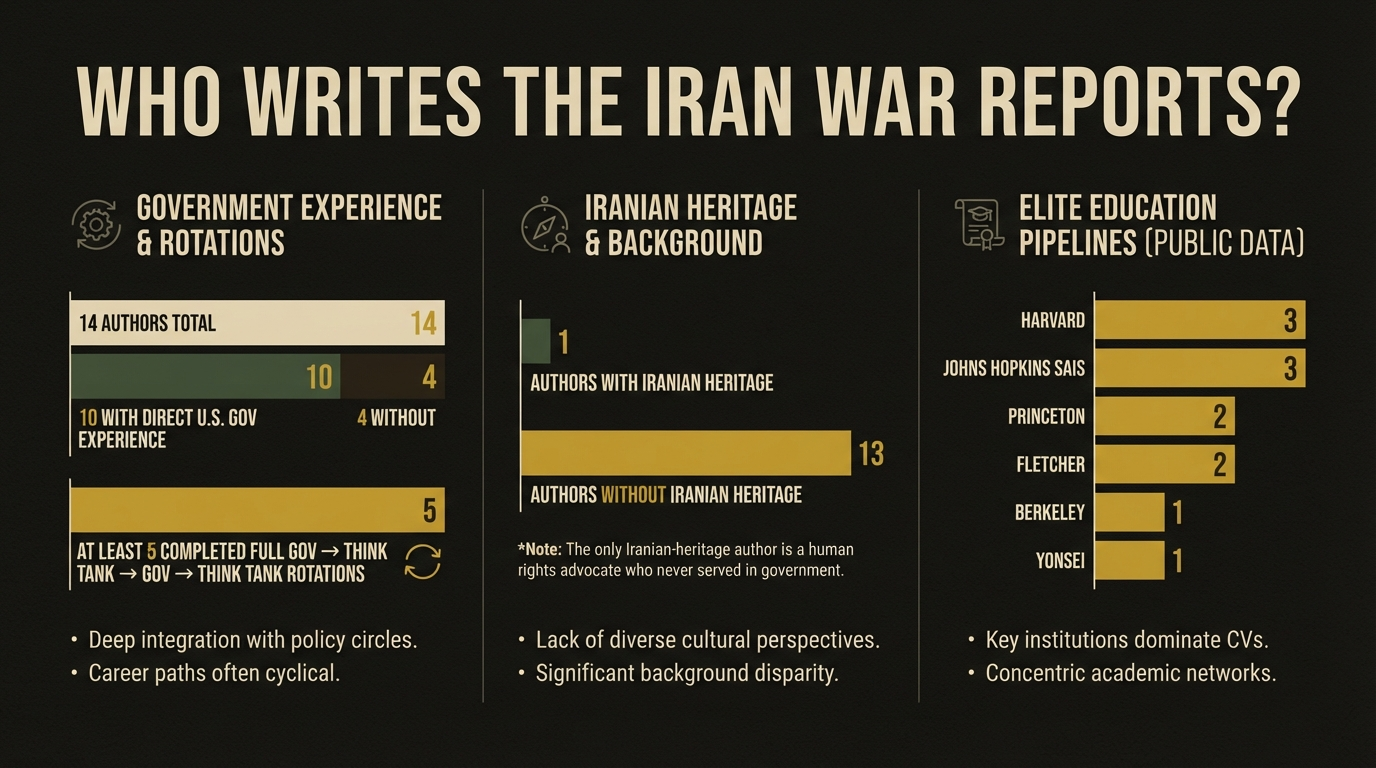
After analyzing 14 biographies, several persistent patterns emerge.
Pattern 1: Government → Think Tank → Government (The Revolving Door)
Of the 14 authors, 10 have direct U.S. Government experience (State Department, Pentagon, NSC, intelligence community). Of those ten, at least 5 have completed a full rotation: government → think tank → government → back to think tank.
This means the authors aren't just commenting on policy, they are the policy. Swanson wrote Iran policy at the NSC and now comments on it at the Atlantic Council. Karlin wrote the National Defense Strategy and now analyzes its consequences at Brookings. Shapiro carried out Arab normalization and now evaluates its results.
Pattern 2: Almost No Iranians
Of the 14 authors, only one, Gissou Nia, has Iranian heritage. And she's the only one who never passed through the government apparatus. Everyone else views Iran from the outside: from the Pentagon, the State Department, the intelligence community, a hedge fund, ExxonMobil.
None of them speak Farsi (except Nia). None have lived in Iran. None hold an academic specialization in Iranian culture, history, or society (Maloney comes closest, but her PhD is in international relations, not Iranian studies).
Imagine a panel of "Russia experts" composed entirely of former Pentagon officials and Lockheed Martin analysts, without a single Russianist. That's what this looks like.
Pattern 3: Elite Education as the Entry Ticket
Harvard (Girishankar, Peek, Gordon), Johns Hopkins SAIS (Peek, Karlin, Sahay), Georgetown (Kroenig), Princeton (Peek), Tufts Fletcher (Maloney), UC Berkeley (Gross). Yonsei (Draudt-Véjares) is the only non-American institution on the list.
This isn't a coincidence. Harvard Kennedy School and Johns Hopkins SAIS are the two main talent factories for the Washington foreign policy establishment. Their graduates land in State Department and Pentagon internship programs, then move on to think tanks, and around the cycle goes. The system reproduces itself.
Pattern 4: Defense Ties Are Everywhere, Disclosed Nowhere
Not a single author discloses conflicts of interest in their publications. There are no footnotes saying "the author previously worked at the Pentagon," no disclaimers reading "this think tank is funded by Lockheed Martin." Biographies are available on the websites, but they're presented as credentials, not as potential conflicts:
• "Served as Deputy Assistant Secretary of Defense" = credential
• "Wrote the policy now being implemented in the war he's analyzing" = conflict of interest
Same sentence. Two different frames. Think tanks offer the first; we need to see the second.
IV. The Money: Who Pays for Expertise
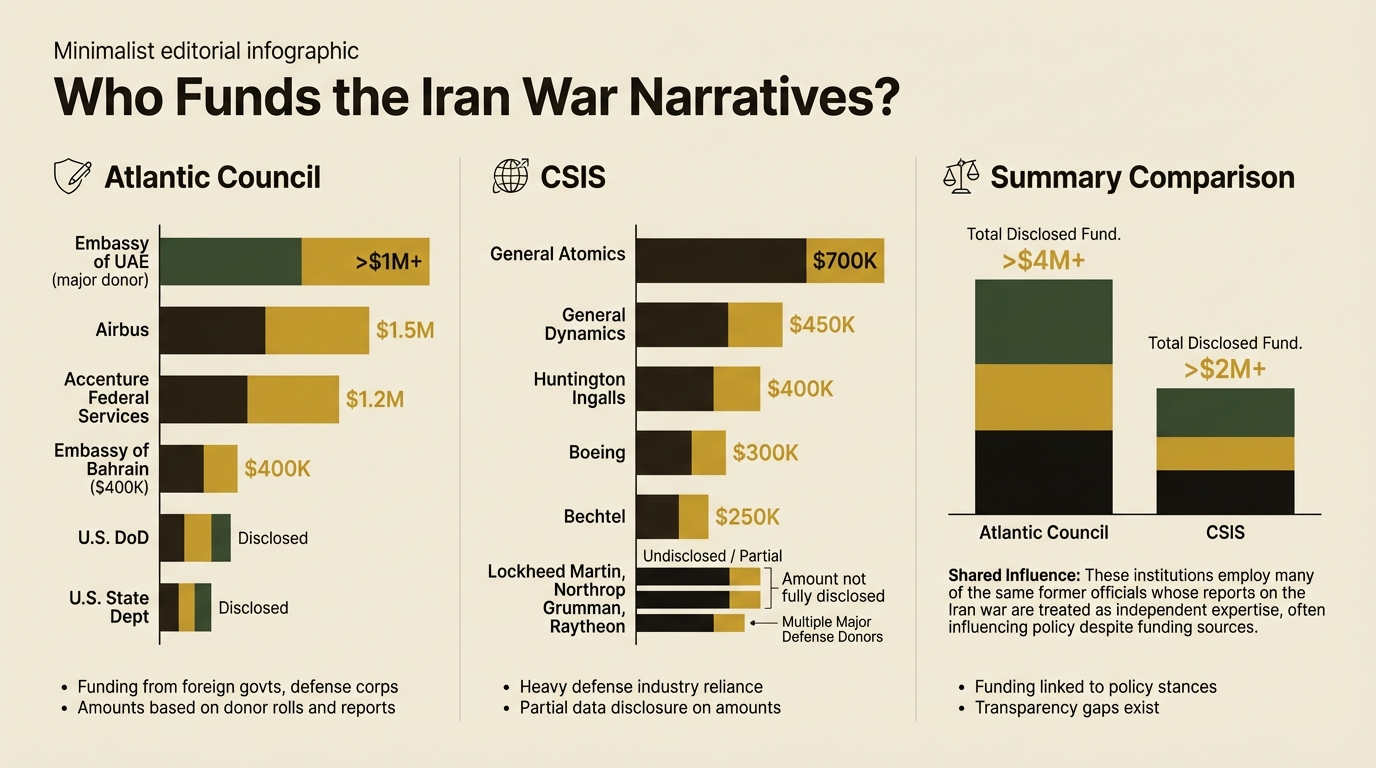
Key Atlantic Council Donors (from the public Honor Roll of Contributors):
• Embassy of the United Arab Emirates (major donor)
• Goldman Sachs
• United States Department of Defense
• United States Department of State
• Bahrain (Embassy of Bahrain, $400K)
• Airbus, $1.5M (largest single defense donor)
• Accenture (via Accenture Federal Services), $1.2M
Key CSIS Donors:
• General Atomics, $700K
• General Dynamics, $450K
• Huntington Ingalls, $400K
• Boeing, $300K
• Bechtel, $250K
• Northrop Grumman, Lockheed Martin, Raytheon (RTX), amounts not fully disclosed
What this means in practice:
When the Atlantic Council publishes a report claiming the war with Iran is "manageable" and the U.S. Should "see the mission through," that report is written by former Pentagon officials and funded by defense contractors who hold contracts for the weapons being used in that war.
This isn't a conspiracy theory. It's a structure. Nobody calls Swanson and says: "Write that the war is a good idea." The structure works more quietly than that. Swanson spent his entire career in a system that treats the Iranian threat as a top priority. The Atlantic Council hires exactly those kinds of people. Defense contractors fund the Atlantic Council because it advances positions compatible with their business interests. Every element acts "rationally." The result is systemic bias.
V. Exceptions That Prove the Rule
Not all authors fit this model. And the exceptions are telling.
Darcie Draudt-Véjares (Carnegie), the only genuine regional specialist among all the authors. A PhD in political science focused on Korea, fluent Korean, experience living in the country. Her analysis that we have covered earlier is the only one that looks at the war from outside Washington. It's no accident she works at Carnegie, the think tank with the smallest defense funding.
Tim Sahay (Carnegie), not a bureaucrat or military figure, but an academic and climate activist. His presence on the author roster is a deliberate Carnegie choice in favor of interdisciplinary perspectives.
Gissou Nia (Atlantic Council), a human rights advocate, not a bureaucrat. But her voice gets drowned out by the chorus of former NSC directors and deputy assistant secretaries of defense.
The pattern is clear: the farther the author stands from the defense establishment, the more unconventional the analysis. And the less institutional weight that person carries within the system.
VI. Conclusion: A System, Not a Conspiracy
We're not claiming the authors of these reports are lying, manipulating, or taking orders. Most of them are qualified professionals who genuinely believe in their analysis.
The problem isn't the people. The problem is the system.
Here's how it works:
1. Recruitment: Think tanks hire former officials because their "experience" is valued as expertise
2. Funding: Defense contractors fund think tanks that hire former officials who advance policy positions compatible with the contractors' interests
3. Media: Journalists quote "think tank experts" without mentioning their government biographies or funding sources
4. Policy: Politicians use think tank reports as "independent expertise" to justify decisions that the same people helped formulate in their previous jobs
The result is a closed loop where the same people, the same ideas, and the same money circulate between government, think tanks, the defense industry, and the media. Every participant plays their part in good faith. But the cumulative effect is a narrowing of the analytical spectrum to whatever the defense establishment finds acceptable.
When 10 out of 14 authors are former officials, and not one of the 14 is an Iranian scholar, an anti-war activist, or an economist from a sanctions-hit country, that's not a diversity of opinion. That's one perspective, replicated across five institutional addresses.